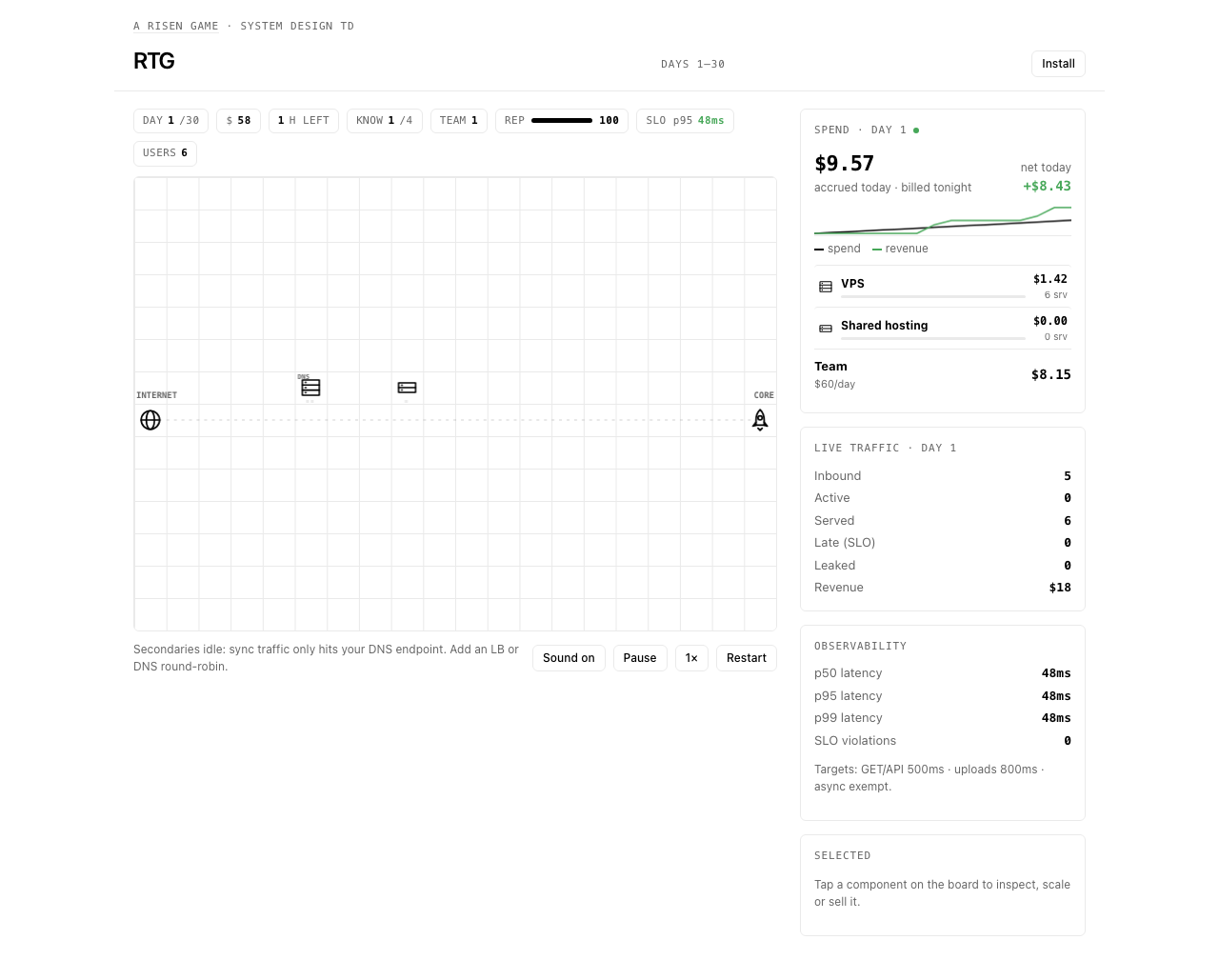
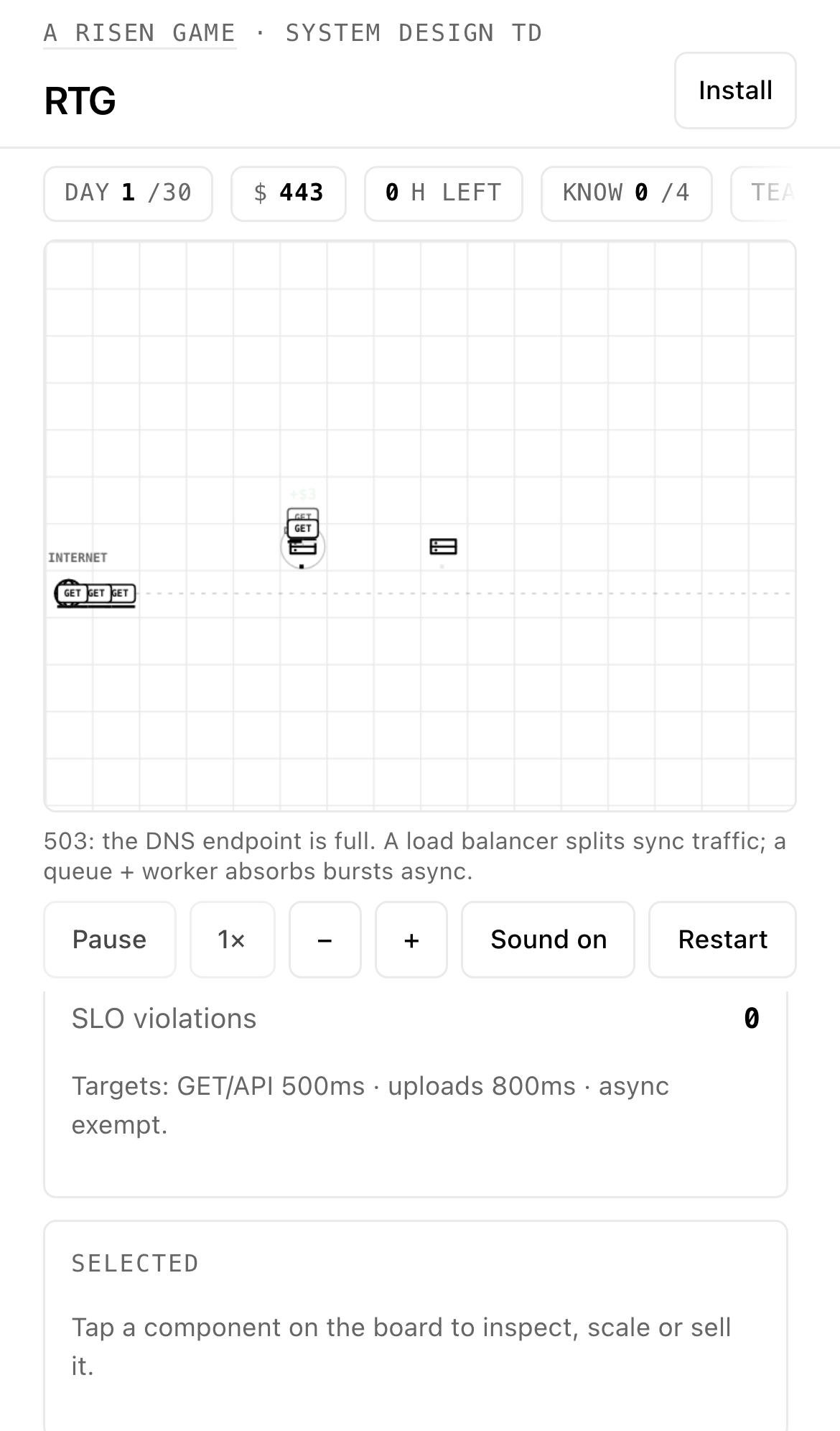
The board is a living architecture diagram. Requests are packets; your infrastructure serves them — or sheds them.
How it plays
- Plan your day. Eight hours to split between work (cash), study (knowledge), building, hiring and marketing. Upkeep and salaries bill nightly.
- Survive the traffic. Requests pathfind from the Internet to your Core. Serve them for money and users; leaks cost reputation. Thirty days to launch, with an HN front-page spike and a launch-day DDoS.
- Scale like a real system. Without a load balancer, all traffic hits your DNS endpoint and secondaries idle. Add an LB, DNS round-robin, caches at the edge, and a queue bus that workers drain from anywhere.
Realistic under the hood
Connections, not hit points
Servers accept up to their concurrency; full servers return 503 and traffic walks on. Queues buffer async work; workers compete as consumers.
Latency SLOs
Latency is queueing + processing. Miss the SLO and users pay but churn. Live p50/p95/p99 and a violation count, always on screen.
Real billing
Instances bill base + usage, bigger iron bills more. The spend dashboard meters every component live; the nightly bill is what actually accrued.
Incidents
Region outages, cache stampedes, memory leaks. Click the pulsing component to mitigate — or watch your p95 climb.
Play anywhere
RTG is a progressive web app: open it once, add it to your home screen, and it runs fully offline — on a plane, on the subway, on a phone or a laptop. No account, no server calls, your save stays on your device.
On iPhone: open in Safari, tap Install, then Share → Add to Home Screen.